










Start Here
How to Design an Outdoor Kitchen That Works the First Time
Most outdoor kitchens aren’t ruined by a bad product. They’re ruined by decisions made in the wrong order — a grill chosen before the layout, a covered patio built without ventilation, a beautiful island framed in materials that don’t survive the climate it lives in. The good news: every one of those mistakes is avoidable, and they almost always trace back to sequence. Decide things in the right order and the rest falls into place. Here’s how a designer actually thinks through it — six decisions, in the order they matter, the trap waiting at each one, and the right way to handle it.
This isn’t a product page. It’s the thinking that should happen before you buy a single thing. When you’re ready, we’ll point you to the right next step.
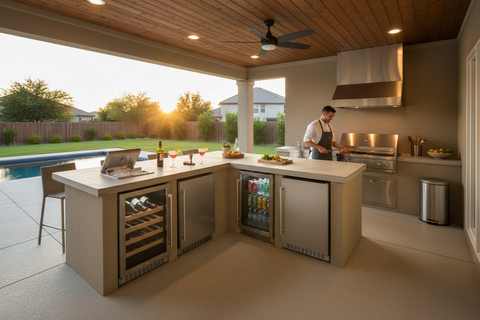
Where the kitchen sits determines how far you have to run gas, water, and power, how much shade and shelter it gets, and how the whole space flows. Where the cook faces determines whether you’re part of the gathering or turned away from it. Lock this in first — moving it later means moving everything.
The traps
- Cooking with your back to your guests. The entire point of an outdoor kitchen is to stay in the party while you cook. A grill turned into a wall or the house isolates the one person who should be at the center of it.
- Ignoring the wind. Prevailing wind blowing smoke into your face — or knocking out your burners — turns a great setup into a miserable one.
- Putting it too far from the house. Every step between the indoor and outdoor kitchen is a step you’ll take a hundred times.
The right way
Stand in the space before you commit. Note where the sun tracks through the afternoon and evening, which direction the wind usually comes from, and where your guests will naturally gather. Orient the cook to face out toward that gathering, position the kitchen close enough to the house for easy trips but far enough that smoke doesn’t drift back inside, and let the prevailing wind carry smoke away from both the cook and the seating. Get this right and everything downstream gets easier.
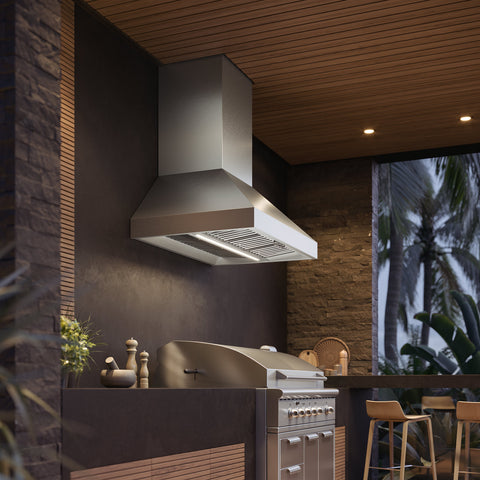
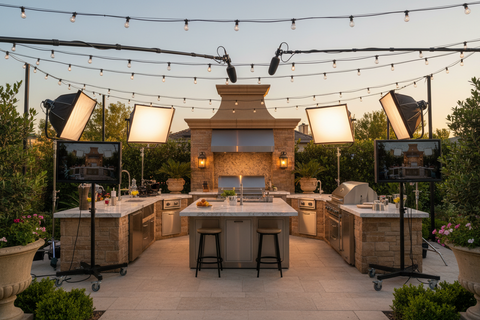
“It’s outside, so it doesn’t need ventilation” is the most expensive assumption people make. The moment you put a roof, pergola, or any structure over a gas grill, you’ve created a space where heat, smoke, and gas can collect. That’s not a comfort issue — it’s a safety one. And your cover decision dictates the venting spec, which dictates how the island around the grill gets built. So it comes before the grill, not after.
The traps
- A covered structure with no ventilation. Built-in grills under any cover need proper island venting and, in many cases, an overhead hood to move heat and grease safely. Skipping this is dangerous and quietly degrades everything around it over time.
- Fully exposed, no shelter at all. The opposite mistake. Sun and rain are hard on outdoor-rated appliances and brutal on the cook in peak summer.
- Trapping heat and smoke. A solid roof set too low or too enclosed turns the cooking zone into an oven.
The right way
Decide early whether you’re building covered, partially covered, or open — because each path has different requirements. If you’re covering it, plan for ventilation from the start: adequate island venting for built-in grills, and an overhead hood sized to the cooking surface when the structure is enclosed enough to trap smoke. If you’re going open, build in some shade or shelter anyway — a pergola, a sail, a partial roof — to protect the equipment and extend the hours you’ll actually want to be outside. The goal is airflow that moves heat and smoke up and away, not a box that holds it in.
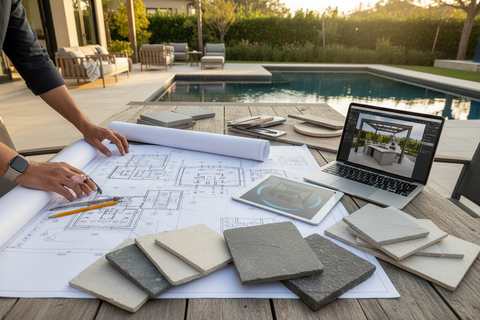
Everything to this point — where it sits, whether it’s covered — tells you where the lines need to run. Get the invisible infrastructure right while it’s still easy, because once the island is built and the patio is poured, retrofitting a gas line or a drain is the expensive nightmare. Plan for more than you think you need: the fridge, the ice maker, the task lighting, the side burner you’ll add in year two.
The traps
- A gas line sized only for today. Run capacity for what the kitchen will become, not just the single grill you’re starting with.
- Forgetting drainage. Sinks, ice makers, and rain all need somewhere to go. No drainage plan means standing water and a sink you can’t really use.
- Underpowering it. Refrigeration, lighting, and powered accessories all need dedicated, outdoor-rated electrical. One forgotten circuit means an extension cord across the patio forever.
The right way
Map every utility before the build, based on the full vision — not just phase one. Size the gas line for the grill plus the side burner and any future additions. Run a dedicated outdoor-rated electrical circuit (or two) with enough capacity for refrigeration, lighting, and accessories. Plan drainage for every water source and for runoff. The principle: it costs a little to rough in extra capacity now and a fortune to add it later, so build the infrastructure for the kitchen you’ll have in five years, not the one you’re starting with.
Now you build the island itself — and this is where climate quietly decides whether your kitchen looks the same in five years or falls apart. The fundamentals are universal: no indoor-grade materials outdoors, and never combustible framing near the grill without an insulated jacket between the heat and the material. But beyond those, the right build depends entirely on where you live. What survives a desert won’t necessarily survive the coast.
The traps
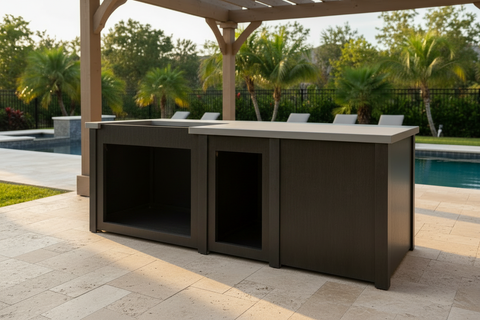
- Indoor materials outdoors, anywhere. Particle board swells, standard hardware rusts, and indoor stone cracks. Marine-grade polymer cabinets, stainless hardware, and non-combustible framing exist because the regular versions don’t last outside. This is not the place to save money.
- Combustible framing without protection. Any wood near the grill needs an insulated jacket between the heat and the material. This is a genuine fire-safety requirement, not a nicety.
- Ignoring your specific climate. The biggest material mistake is assuming “outdoor-rated” means the same thing everywhere. It doesn’t.
The right way — by climate
Humid & Subtropical (Southeast, Gulf)
Heat and constant moisture are relentless. Lean on stainless steel rated for outdoor use (higher grades resist corrosion), sealed stone or porcelain surfaces, and framing that won’t absorb moisture. Non-porous wins — watch for mold and mildew on porous materials.
Coastal & Marine
Salt air is corrosive in a way nothing else is. Standard stainless can still pit and rust near the ocean — specify marine-grade stainless (316, not 304) for hardware and appliances, and rinse exposed metal regularly. Marine-grade polymer cabinetry was built for exactly this.
Cold, Mountain & Freeze-Thaw
The freeze-thaw cycle is the destroyer. Water gets into porous materials, freezes, expands, and cracks them apart over seasons. Avoid cement board and untreated masonry; favor stone block, sealed concrete, or metal framing. Plan for winterizing water lines.
Dry & Desert
Intense UV and big day-to-night temperature swings are the stressors. Sun fades and degrades lower-grade polymers and finishes — specify UV-stable materials and finishes, and account for expansion and contraction with the temperature swing.
The principle across all of them: figure out what your climate does to materials first, then choose the build that’s engineered to take it.
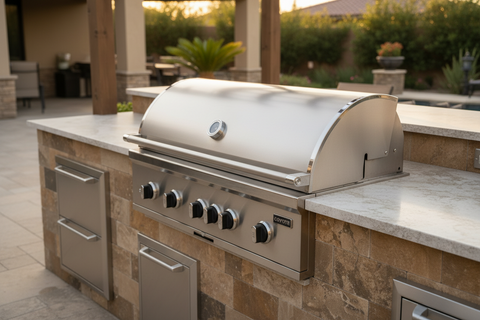
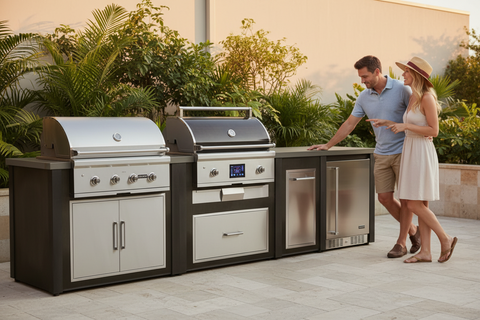
This is the part everyone wants to start with, and it belongs here — after the space that has to hold it is defined. The most common workflow mistake is falling for the biggest grill you can afford and then discovering there’s no room left to actually cook. You need clear counter on both sides: somewhere to land raw food going on, somewhere to rest hot platters coming off.
The traps
- Oversizing the grill. A grill too big for the island eats the prep space that makes the kitchen usable. Bigger isn’t better if you’ve got nowhere to set down a tray.
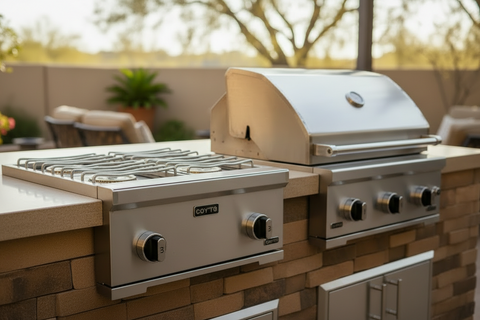
- No landing zone. Counter space on both sides of the cooking surface isn’t optional — it’s the difference between a kitchen and a grill on a stand.
- Buying the appliance before the layout can hold it. A specific model’s footprint, clearances, and ventilation needs have to fit before you commit.
The right way
Start from the space and work inward. Decide how much total counter you have, reserve generous landing zones on both sides of the cooking surface, and let what’s left define the grill size — not the reverse. Think through the actual workflow: raw food lands here, goes on the grill, comes off to rest there, gets served from here. A kitchen that follows the way you really cook feels effortless; one built around an oversized centerpiece fights you every time. When you’ve got a model in mind, confirm its footprint, clearances, and ventilation against the space before you commit — which is exactly the kind of check we’ll run with you.
These are the things nobody puts on their wish list and everybody wishes they’d included. They’re what separates a kitchen you use from one you keep walking away from. Designed in from the start, they cost little. Added after the build, they’re a renovation.
The traps
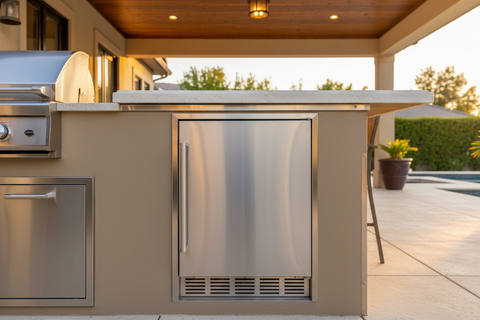
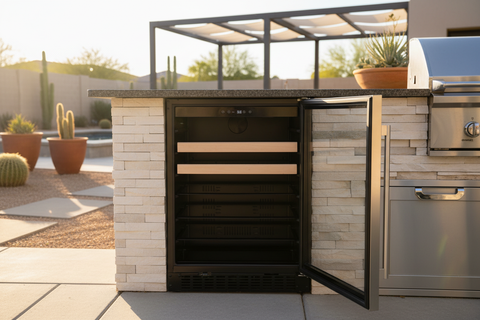
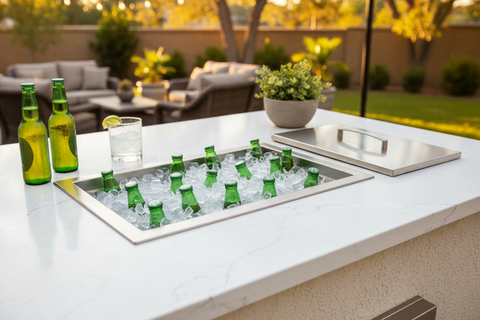
- No cold storage. Without an outdoor-rated fridge or beverage center, you’re walking back inside for every drink and condiment. The whole point was not to.
- Nowhere for waste. A built-in or pull-out trash bin sounds minor until you’re carrying scraps through the house mid-cook.
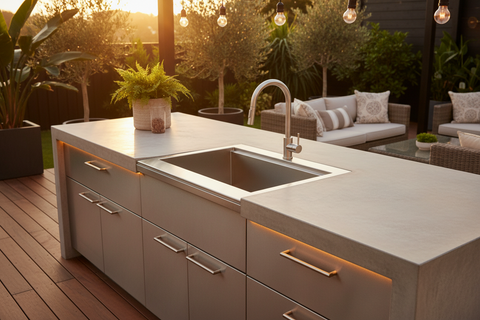
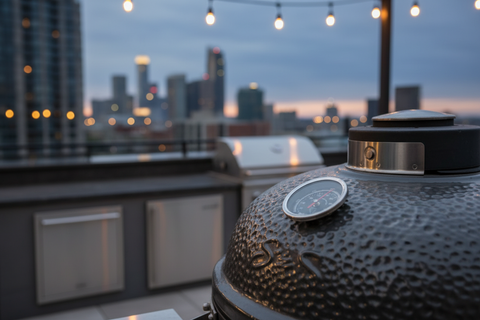
- No task lighting. Most grilling happens after dark. Ambient string lights are lovely and useless for telling when your steak is done.
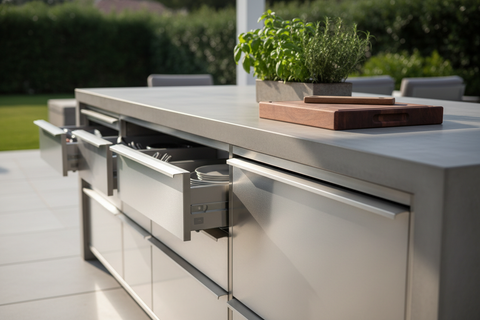
- Skipping the finishing details. Insulated jackets, drawer configurations, the right accessories — the things that make a build feel finished rather than assembled.
The right way
Treat these as part of the original plan, not an afterthought. Build in outdoor-rated cold storage so drinks and ingredients live where you cook. Designate a spot for waste — a pull-out bin keeps it out of sight and out of the way. Add dedicated, bright task lighting over the grill and prep areas (you’ll cook in the dark more than you expect), with softer ambient lighting for everything around it. And spend the small money on the finishing pieces — drawers, jackets, the right accessories — that turn a collection of appliances into a kitchen. None of these are expensive when they’re in the plan. All of them are when they’re not.
You Don’t Have to Get This Right Alone.
Getting the sequence right is exactly what we do. Every Luxe Patios build includes expert guidance — we help confirm sizing, check specs and clearances, and make sure the pieces work together before you commit to anything. Wherever you are and whatever your climate demands, we’ll help you build it once and build it right.
